


This post is also available in:  Italiano
 Español
Causes, Inspections and Solutions for Assessing Component Conformity
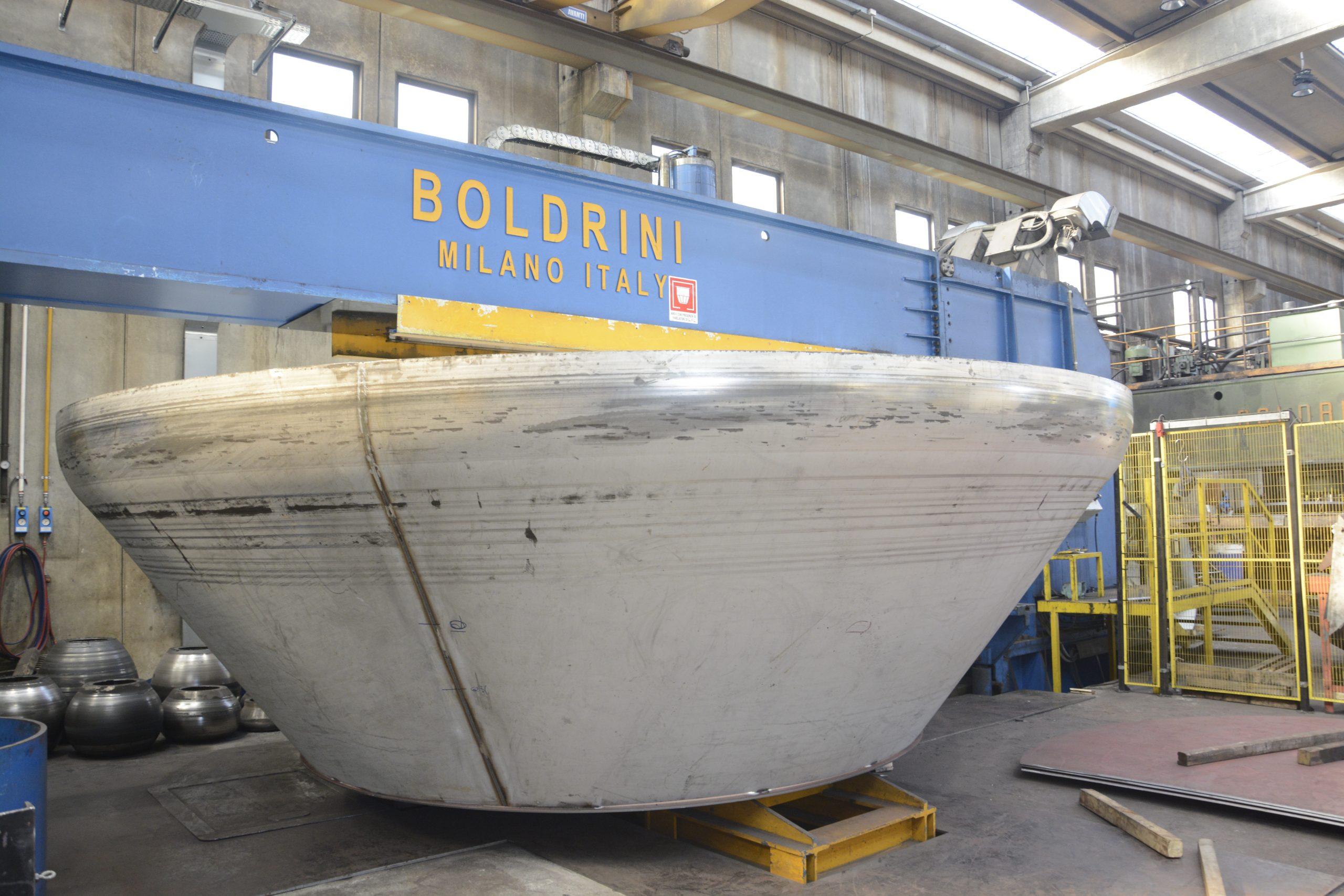
Flanging deformations and transport-related dents in conical heads are two different phenomena that require specific inspections to determine their origin and impact on component functionality. The former may result from the forming process and the material’s elastic springback, while the latter are generally associated with impacts or concentrated pressure during handling.
When a conical head shows a profile that is not perfectly straight or has a dent, the initial assessment should therefore go beyond visual appearance.
A correct diagnosis makes it possible to determine whether the component is compliant, can be repaired or needs to be remanufactured, avoiding hasty decisions and unsupported attribution of responsibility.
Geometrical Characteristics of Conical Heads
Conical heads have specific geometrical characteristics that influence how the material behaves during manufacturing.
Unlike cylindrical components or traditional dished heads, a cone responds differently to deformation. Cone angle, diameters, height, thickness, material and the length of the section to be flanged determine how deformation is distributed along the circumference and generatrix.
In particularly sensitive geometries, flanging may cause elastic springback, local profile variations or a bell-shaped deformation.
These phenomena do not automatically indicate a manufacturing defect. They must be assessed against the technical drawing, agreed tolerances and the component’s intended function within the assembly.
The manufacturer’s expertise lies in distinguishing the natural effects of the manufacturing process from deviations that actually affect assembly, welding or final performance.
Deformations Caused by Conical Head Flanging
During conical head flanging, the edge undergoes plastic deformation to obtain the section required for joining.
At this stage of the forming and flanging process, the material is simultaneously subjected to bending, tension and compression. Once the applied load is removed, elastic springback may partially alter the geometry achieved.
On certain cones, for example, the edge may appear slightly turned inward, or the profile may become more open towards the end.
To determine whether a deformation is acceptable, the assessment must be based on objective dimensional measurements, including:
- Diameters and roundness.
- Component height.
- Generatrix inclination.
- Edge flatness.
- Ability to fit with the cylindrical shell or the next component.
Only by comparing these measurements with the technical drawing and agreed tolerances is it possible to determine whether the deformation falls within acceptable limits or requires correction.
Handling and Transport Dents: Characteristics and Differences
Unlike geometrical variations caused by flanging, a dent is a localised deformation, generally associated with an impact or concentrated pressure.
This type of damage affects a limited area and disrupts the continuity of the surface differently from the distributed deformation produced by the flanging process.
To assess its possible origin, it is important to consider the dent’s location, depth, any surface marks and the condition of the packaging.
These elements help distinguish a manufacturing-related deviation from damage that may have occurred during handling or transport.
Comparison Between Flanging Deformations and Transport Dents
| Element | Flanging Deformation | Handling-Related Dent |
|---|---|---|
| Distribution | Extends along the edge or profile | Concentrated in a limited area |
| Typical cause | Deformation balance and elastic springback | Impact during handling or transport |
| Inspection | Dimensions, roundness, profile and fit-up | Depth, marks, location and photographs |
| Possible action | Acceptance, sizing or controlled correction | Local repair or remanufacturing |
Distinguishing between these two phenomena is essential to identify the appropriate corrective action and properly assess any potential responsibilities.
Dimensional Inspections and Documentation Before Shipment
To reliably distinguish a manufacturing-related deviation from an event occurring after delivery, it is essential to have documented inspections carried out before conical heads are shipped.
Final inspection may include dimensional verification, visual examination, photographs of the surfaces and edges, inspection result records and images of the completed packaging.
Photographic traceability does not replace technical inspection, but it makes it possible to compare the condition of the component before dispatch with its condition upon arrival.
In the event of a reported issue, this documentation speeds up the analysis and helps distinguish different phenomena without relying solely on visual impressions.
Conical Head Packaging and Transport: Managing the Risk of Damage
Packaging plays an important role in managing the risk of damage to conical heads during handling and transport.
Packaging requirements must be defined by considering the component’s weight, geometry, support points and surface sensitivity.
A pallet with external protection may be suitable under certain conditions. However, groupage transport exposes the product to more handling operations and possible contact with other loads.
For particularly sensitive components, several solutions may therefore be considered, including spacers, rigid protective structures, anti-contact systems or dedicated transport.
EXW Terms and Risk Allocation Under Incoterms 2020
The agreed commercial delivery terms also affect how transport risks are managed.
Under EXW (Ex Works) as defined by Incoterms 2020, unless otherwise agreed contractually, transport is arranged by the buyer and the risk transfers when the goods are placed at the buyer’s disposal at the agreed location, ready for loading.
It remains essential to clearly define the required level of packaging and document the condition of the product at the time of delivery.
Repair or Remanufacturing of a Deformed Conical Head
The possibility of repairing a conical head depends on the type and extent of the deviation and its consequences for the component’s dimensional and functional characteristics.
The main possible interventions are local correction, geometrical sizing or remanufacturing.
Local Correction of Dents
A small dent can sometimes be repaired through controlled cold straightening, using non-aggressive tools.
Before performing the operation, the material, thickness, position and depth of the dent must be assessed, together with the risk of leaving surface marks or introducing further deformations.
Geometrical Sizing After Flanging
When the deviation affects the profile produced by flanging, controlled correction or sizing may be considered.
This solution is possible provided that sufficient technical and dimensional margins are available to perform the intervention.
Component Remanufacturing
If the damage compromises dimensional requirements, fit-up or the required quality, or if repair cannot guarantee a verifiable result, remanufacturing remains the safest option.
The decision must therefore be based on a technical assessment rather than on the mere presence of a visible deformation.
Technical Management of Non-Conformities in Conical Heads
Technical non-conformity management requires a documented approach that clearly distinguishes between the description of the deviation, its cause and responsibility.
The first step is to collect photographs, measurements, transport documents and information about the packaging.
The deviations are then classified, their effects on component functionality are assessed, and possible corrective actions are defined, taking into account both time and costs.
Only after this analysis is it appropriate to establish responsibilities and any potential commercial solution.
This approach protects both parties: it avoids attributing transport damage to the manufacturing process while also preventing the underestimation of a geometrical deviation that could interfere with the component’s intended use.
Quality does not mean denying a problem, but understanding it quickly and proposing a proportionate solution.
Tommasin Fondi’s Expertise in Forming and Deformation Assessment
Tommasin Fondi has been operating in the cold forming of dished, conical and hemispherical heads for over fifty years.
Its experience with special geometries makes it possible to recognise the typical effects of flanging, correctly interpret deformations and assess their actual impact on assembly and component functionality.
The same expertise is applied after delivery through evidence analysis, communication with the customer, repair or remanufacturing proposals and the search for a balanced solution.
To assess the manufacturability of a conical head or define suitable inspections and packaging requirements, contact the Tommasin Fondi team and provide the technical drawing, material, thickness, tolerances, transport arrangements and acceptance requirements.
Technical references: principles of plastic forming and sheet metal elastic springback; International Chamber of Commerce Incoterms 2020.
 Previous Article
 All News


